


Planning around BC statutory holidays 2026 is easier when you know which dates are truly statutory. British Columbia has 11 statutory holidays in 2026, from New Year’s Day on January 1 to Christmas Day on December 25. Easter Monday and Boxing Day are not statutory holidays for most provincially regulated employees.
| Statutory holiday | 2026 date | Day |
| New Year’s Day | January 1 | Thursday |
| Family Day | February 16 | Monday |
| Good Friday | April 3 | Friday |
| Victoria Day | May 18 | Monday |
| Canada Day | July 1 | Wednesday |
| B.C. Day | August 3 | Monday |
| Labor Day | September 7 | Monday |
| National Day for Truth and Reconciliation | September 30 | Wednesday |
| Thanksgiving Day | October 12 | Monday |
| Remembrance Day | November 11 | Wednesday |
| Christmas Day | December 25 | Friday |
The dates above match the Province of British Columbia’s official 2026 statutory holiday calendar.
Key Takeaways
- British Columbia has 11 provincial statutory holidays in 2026.
- Six holidays naturally create a three-day weekend for many Monday-to-Friday workers.
- Easter Sunday, Easter Monday, and Boxing Day are not provincial statutory holidays in B.C.
- Eligible workers may receive an average day’s pay when they have a statutory holiday off.
- Qualifying employees who work on a statutory holiday generally receive premium pay plus an average day’s pay.
- Federal employees can follow a different holiday calendar from provincially regulated employees.
BC Stat Holidays 2026: The Official 11 Dates
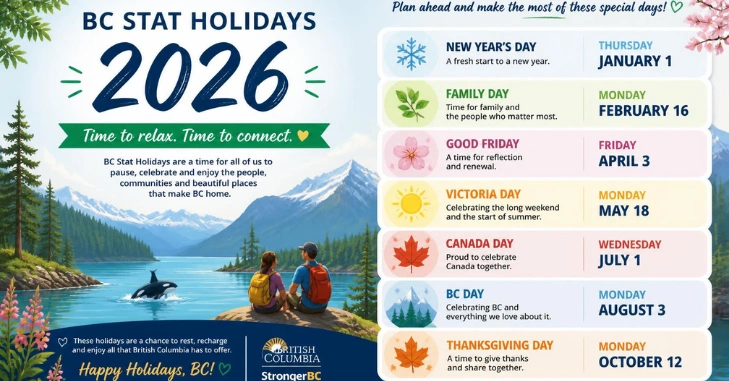
The year begins with New Year’s Day on Thursday, January 1. Family Day follows on Monday, February 16. Good Friday falls on April 3, while Victoria Day is Monday, May 18. Canada Day arrives midweek on Wednesday, July 1.
The BC Stat Holidays 2026 calendar continues with B.C. Day on Monday, August 3, followed by Labour Day on Monday, September 7. The National Day for Truth and Reconciliation falls on Wednesday, September 30, while Thanksgiving is Monday, October 12.
Remembrance Day falls on Wednesday, November 11, and Christmas Day closes the provincial calendar on Friday, December 25. Knowing these BC Stat Holidays 2026 dates can help employees plan vacations, long weekends, family activities, and time away from work.
Readers comparing provinces should not assume every Canadian province follows the same list. Lifevoria’s Ontario 2026 statutory holiday guide shows how provincial rules can result in different numbers of paid public holidays.
Which B.C. Holidays Create Long Weekends in 2026?
Several dates line up neatly with Saturday and Sunday. That makes 2026 a useful year for planning short trips or family time without using many vacation days.
| Holiday | Statutory date | Typical long weekend |
| Family Day | Monday, February 16 | February 14–16 |
| Good Friday | Friday, April 3 | April 3–5 |
| Victoria Day | Monday, May 18 | May 16–18 |
| B.C. Day | Monday, August 3 | August 1–3 |
| Labor Day | Monday, September 7 | September 5–7 |
| Thanksgiving | Monday, October 12 | October 10–12 |
| Christmas Day | Friday, December 25 | December 25–27 |
New Year’s Day falls on a Thursday. Taking Friday, January 2, as an approved vacation day could result in four consecutive days away from work for someone on a Monday-to-Friday schedule.
Canada Day, September 30, and Remembrance Day all fall on Wednesdays. Those dates do not create automatic three-day weekends. Workers planning an autumn trip can also compare Thanksgiving timing with Lifevoria’s October long weekend guide. The site’s Labour Day guide in Canada provides additional background on the September holiday.
Easter Monday and Boxing Day Are Not B.C. Statutory Holidays
One of the easiest mistakes is counting every familiar holiday on a Canadian calendar as a provincial statutory holiday. In British Columbia, Easter Sunday, Easter Monday, and Boxing Day are not statutory holidays under the general provincial employment standards rules. The official B.C. government guidance states this directly.
In 2026, Easter Monday is April 6. Boxing Day is Saturday, December 26. Your employer can still close the workplace or give you a paid day off. An employment contract or collective agreement may also provide benefits beyond the provincial minimum. That is why an office holiday calendar can contain more dates than the official provincial statutory list.
Who Qualifies for Statutory Holiday Pay in B.C.?
Most employees covered by B.C. employment standards must meet two basic conditions.
You generally need to:
- have been employed for at least 30 calendar days before the holiday; and
- have worked or earned wages on at least 15 of the previous 30 calendar days.
Paid vacation days and certain other days on which wages are earned can count toward that second requirement. Employees working under an averaging agreement can be treated differently.
A common misconception says an employee must work both the day before and the day after a holiday. That is not B.C.’s general qualification test. The province specifically explains that the rule is based on employment length and the previous 30 calendar days.
Some occupations and employment arrangements are excluded from the normal rules. Employees unsure about their coverage should check the current Employment Standards Regulation or provincial guidance.
How Is Statutory Holiday Pay Calculated?
For an eligible employee, statutory holiday pay is generally based on an average day’s pay.
The basic formula is
Total qualifying wages earned during the previous 30 calendar days ÷ number of days worked or earning wages = average day’s pay.
Overtime wages are excluded from the calculation. Regular wages, salary, commission, paid vacation, statutory holiday pay, and required paid sick days can be included under the provincial rules.
For example, the province provides a case in which an employee had $3,200 in qualifying wages over 20 paid working days. The statutory holiday amount was
$3,200 ÷ 20 = $160
Your result can differ because the calculation uses your own wages and qualifying days. The province’s statutory holiday pay guidance should be the main reference when checking a real payroll calculation.
What Happens If You Work on a Statutory Holiday?
Qualifying employees can receive more than their regular hourly wage when they work on a provincial statutory holiday. Under the current B.C. Employment Standards Act, an eligible employee who works on a statutory holiday is generally entitled to:
- 1.5 times the regular wage for hours worked up to 12 hours;
- double time for hours worked beyond 12 hours; and
- an average day’s pay in addition to the premium wages.
These rules are set out in sections 45 and 46 of the Employment Standards Act. Workers who do not qualify for statutory holiday entitlement may receive their regular wages for hours worked instead. Individual circumstances and excluded occupations can change the answer.
What If the Holiday Falls on Your Regular Day Off?
A qualifying employee can still be entitled to an average day’s pay when a statutory holiday falls on a normal day off. B.C. guidance also states that an employer is not automatically required to provide another day off simply because the statutory date landed on the employee’s regular day off.
That differs from rules found in some other Canadian jurisdictions. Check the employment law that applies to your workplace before assuming an observed Monday or substitute day will be provided.
Can an Employer Substitute Another Day?
Yes. B.C. rules allow another day to replace a statutory holiday when the required agreement is in place. For an individual employee, the employer and employee can agree to a substitute day. For a group of affected workers, majority-agreement requirements may apply.
The substitute day then carries the statutory-holiday rights that would have applied to the original date. A workplace may therefore operate normally on the calendar holiday while treating another agreed date as the paid statutory day. Employees should get the arrangement clearly documented rather than relying on an informal assumption.
Provincial and Federal Holiday Rules Are Different
Living in British Columbia does not automatically mean the provincial rules govern your job. Federally regulated workplaces follow federal labor standards. Examples can include banks, airlines, telecommunications businesses, postal services, and certain interprovincial transportation operations. Federal labor standards recognize 10 general holidays, including Boxing Day. Family Day is not among the federal list.
That creates an important difference. A provincially regulated B.C. employee may have Family Day as a statutory holiday but not Boxing Day. A federally regulated employee can have Boxing Day as a general holiday but not Family Day under the federal list.
Lifevoria’s Canada public holidays overview can help readers compare Canadian holiday terminology and provincial differences.
How to Plan Your 2026 Days Off
Start with the official 11-date B.C. calendar rather than a generic Canadian holiday list. Then compare those dates with your normal work schedule and vacation allowance.
For many Monday-to-Friday workers, the easiest long-weekend opportunities are
- Family Day in February.
- Good Friday in April.
- Victoria Day in May.
- B.C. Day in August.
- Labor Day in September.
- Thanksgiving in October.
- Christmas weekend in December.
Midweek holidays need a little more planning. Canada Day, September 30, and Remembrance Day all fall on Wednesdays.
Before booking a trip, confirm your approved vacation dates and workplace schedule. A statutory holiday does not mean every business, restaurant, attraction, or transport service will be closed. Also check whether your workplace falls under provincial or federal employment rules.
Add the 2026 Dates to Your Calendar
British Columbia’s 2026 holiday calendar gives many workers several built-in long weekends, plus four useful midweek dates. Add the 11 official dates to your calendar first. Then check your work schedule, provincial or federal jurisdiction, holiday pay eligibility, and any substitute day arrangements before making travel plans.
For a specific employment or payroll dispute, use the Province of British Columbia’s current Employment Standards information rather than relying only on a general calendar.
Conclusion
The BC stat holidays 2026 calendar gives employees and employers 11 provincial statutory holidays to plan around, from New Year’s Day in January through Christmas Day in December. Several of these dates create convenient three-day weekends, while midweek holidays such as Canada Day, the National Day for Truth and Reconciliation, and Remembrance Day may require vacation planning to create longer breaks.
Understanding the difference between a provincial statutory holiday and an employer-provided day off is especially important. Easter Monday and Boxing Day are not statutory holidays under B.C.’s general provincial employment standards rules, even though some workplaces may still observe them.
Frequently Asked Questions
The official list of BC statutory holidays for 2026 contains 11 dates. They begin on New Year’s Day, January 1, and end on Christmas Day, December 25.
No. Boxing Day is not a statutory holiday under B.C.’s general provincial employment standards rules. An employer can still provide it as a paid workplace holiday.
No. Easter Monday is not one of British Columbia’s 11 statutory holidays for most provincially regulated employees. In 2026, Easter Monday falls on April 6.
Yes. The National Day for Truth and Reconciliation is a statutory holiday in British Columbia. In 2026, it falls on Wednesday, September 30.
That is not the general B.C. test. Most covered employees qualify after 30 calendar days of employment and after working or earning wages on 15 of the previous 30 days.
Qualifying employees generally receive an average day’s pay plus time-and-a-half for up to 12 hours worked. Hours beyond 12 are generally paid at double time.