


If you’re considering an ear piercing, the placement is only one part of the decision. The studio, technique, jewelry, and aftercare can all affect comfort and healing. Canadian public-health guidance also makes an important distinction between soft earlobes and cartilage, which needs more careful technique and usually takes longer to heal.
A new piercing is usually straightforward when a trained professional uses sterile equipment and suitable jewelry. Earlobes generally heal faster than cartilage. Choose a reputable studio, follow its written aftercare instructions, and seek medical care if redness, swelling, pain, discharge, or other symptoms worsen rather than improve.
| What to know for Ear Piercing | Practical starting point |
|---|---|
| Easiest first placement | Standard earlobe |
| Lobe healing | Often several weeks; allow extra time before assuming it is fully healed |
| Cartilage healing | Commonly 6 to 12 months |
| Cleaning | Sterile saline 1 to 2 times daily |
| Jewellery movement | Don’t twist or rotate it while healing |
| Cartilage method | A sterile single-use needle is the safer professional approach |
| Main warning signs | Worsening redness, warmth, swelling, pus, severe pain, fever, or chills |
| Canadian studio cost | Varies by placement, jewellery, studio, and city |
Key Takeaways
- A standard lobe is usually the simplest choice for a first placement.
- Cartilage options such as helix, conch, rook, and tragus need longer healing periods.
- Toronto Public Health says piercing devices can be used for earlobes but should not be used on ear cartilage.
- The Canadian Professional Piercers Association recommends gentle cleaning with sterile saline and avoiding unnecessary movement.
- Good initial jewelry should be properly fitted and made from a suitable high-quality material.
- Pain, swelling, or redness that keeps getting worse deserves professional attention.
For more practical everyday content created for Canadian readers, browse Lifevoria’s lifestyle guides.
Common Types and Where They Sit on the Ear
Your anatomy affects which placements will work. A good piercer should examine your ear before promising a particular look.
Lobe
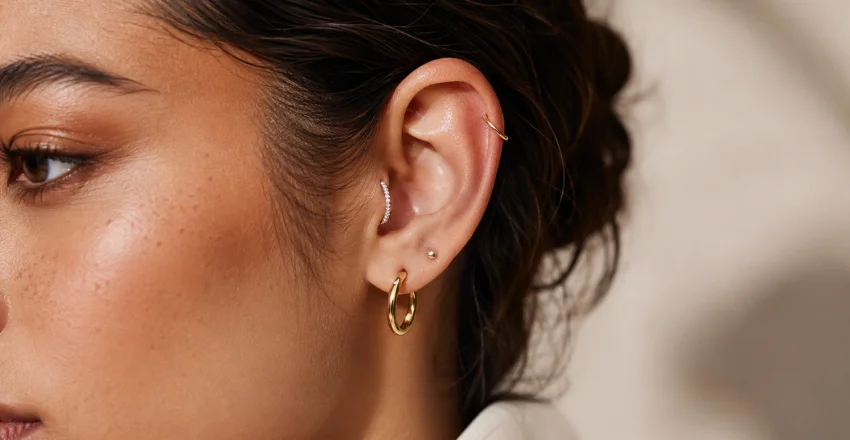
The standard lobe sits in the soft tissue at the bottom of the ear. It is usually one of the least painful options and tends to heal faster than cartilage. Second- and third-lobe placements can create a stacked effect. Their exact spacing should suit the size and shape of your ear rather than follow a fixed template.
Helix and Flat
A helix sits along the outer cartilage rim. A flat sits on the broader upper area inside that rim. These placements work well with small studs and carefully fitted decorative ends. They also require more patience than a basic lobe because cartilage heals slowly.
Conch
The conch sits in the central bowl of the ear. Depending on anatomy and jewelry choice, it can create either a subtle stud look or a stronger statement after healing.
Tragus
The tragus is the small cartilage section beside the entrance to the ear canal. Headphones and earbuds can make healing less convenient, so think about your daily habits before choosing them.
Rook, Daith, and Industrial
These are more anatomy-dependent. A rook passes through an upper inner cartilage fold. A daith sits deeper inside the ear. An industrial connects two holes with one bar. Not every ear can safely support every placement. A professional should be willing to recommend another option if your anatomy does not suit your first choice.
How Long Does Healing Take?
Healing estimates vary because the outside may look settled before the inner channel has finished repairing. Current Canadian Professional Piercers Association guidance lists earlobes at 12 weeks or longer and cartilage placements such as the helix, flat, and conch at about 6 to 12 months.
Other health references sometimes publish shorter lobe estimates. HealthLinkBC, for example, lists about 6 to 8 weeks for facial sites, including earlobes. The practical lesson is not to treat the shortest estimate as a deadline. Keep the starter jewelry in place until the channel is stable and your piercer says a change is appropriate.
Pressure can also slow progress. Sleeping directly on a new cartilage placement, catching it on clothing, or repeatedly using tight headphones can keep the tissue irritated.
How to Choose a Safe Ear Piercing Studio in Canada
Start with the person doing the procedure, not the jewelry display. The Canadian Professional Piercers Association recommends looking for professional experience, clear communication, a clean environment, strong sterilization practices, and quality initial jewelry.
A qualified piercer should also discuss your anatomy, healing expectations, risks, and aftercare before starting.
Ask a few direct questions:
- What sterilization methods do you use?
- Is the needle sterile and single-use?
- What material is the starter jewelry?
- Is this placement suitable for my anatomy?
- How long should I expect it to heal?
- Do you offer follow-up or downsizing appointments?
- What should I do if I develop a problem?
In Ontario, personal service settings are subject to requirements covering hygiene, equipment, sterile single-use sharps, records, and infection prevention. Canada.ca also advises getting tattoos and body piercings in professional settings that comply with applicable standards and local public health requirements.
Unsterilized equipment can expose clients to blood-borne infections. If you like practical checklists for evaluating local professionals, Lifevoria’s guide to choosing a skilled service provider for shoe repair uses a similar principle. Ask what will be done, how much it will cost, and what experience the provider has before committing.
Needle or Piercing Device?
This question matters most when cartilage is involved. Toronto Public Health states that a piercing device may be used on the earlobe. It also states that such a device should not be used on the high ear cartilage, the nose, or the belly button.
For cartilage, look for a professional who uses an appropriate sterile single-use needle. For a low-cost device-based service, ask how the system prevents contamination and whether the components that touch your skin are sterile and single-use.
What jewelry is best for a Fresh Placement?
Starter jewelry needs to support healing, not simply look good on the day of your appointment. The Canadian Professional Piercers Association advises asking about implant-grade materials and properly fitted jewelry. It also flags unknown metals, plated pieces, and externally threaded jewelry as concerns for fresh placements.
Titanium is a common initial option. Suitable medical-grade steel and quality solid gold may also be available, depending on the studio and your sensitivities. Cleveland Clinic also advises avoiding nickel-containing jewelry if you are prone to reactions.
Fit matters as much as material. Jewelry that is too tight may not leave enough room for early swelling. Jewelry that is unnecessarily long can catch on hair, towels, and clothing. Once swelling settles, ask whether a professional downsize would help.
Personal style can come later. The same choose-for-your-real-life approach used in Lifevoria’s guide to creating a personal, practical look at home also works here: start with function, then build the decorative details after the foundation is settled.
Aftercare: Keep It Simple
The Canadian Professional Piercers Association recommends cleaning with sterile saline (0.9% sodium chloride) one or two times daily. Clean fresh water may also be appropriate as directed by your piercer. A simple routine looks like this:
- Wash your hands before you touch the area.
- Rinse gently with sterile saline.
- Leave the jewelry still. Don’t twist or rotate it.
- Pat the area dry with a clean disposable paper product.
- Limit irritation from cosmetics, hair products, pressure, and unnecessary touching.
- Follow your piercer’s instructions for swimming, downsizing, and jewelry changes.
CPPA guidance advises against homemade salt mixtures, alcohol-based products, harsh antiseptics, hydrogen peroxide, and ointments for routine care. It also warns that overcleaning can irritate healing tissue. The association advises avoiding lakes, swimming pools, and baths during the early healing phase. Your piercer can give timing suited to your placement and circumstances.
What Is Normal, and What May Signal an Infection?
Some tenderness, minor swelling, light bleeding, bruising, itching, and pale crusting can occur during normal healing. Symptoms should generally become easier to manage rather than steadily worse.
Contact a healthcare professional if you develop:
- increasing redness, swelling, or warmth;
- green or yellow discharge;
- severe or worsening pain;
- persistent throbbing;
- fever or chills;
- jewelry becoming embedded in the skin.
Toronto Public Health advises seeing a doctor if a piercing develops pus or becomes red, very swollen, or very tender. Those can be signs of infection. Cartilage infections deserve particular attention. Don’t remove jewelry or attempt home treatment for a suspected infection without appropriate professional advice.
How Much Can It Cost in Canada?
There is no reliable single nationwide price because studios structure their fees differently. As a current example, The FALL in Vancouver lists lobe procedures from CA$25, while most cartilage work starts around CA$50 to CA$60, with jewelry priced separately.
Caryl Baker Visage lists its service as included with the purchase of qualifying jewelry, with styles starting around CA$44. Treat those figures as examples, not national averages. Location, jewelry material, placement, number of holes, and follow-up services can change the total.
Ask for the full price before your appointment. Confirm whether it includes jewelry, aftercare products, taxes, downsizing, or follow-up visits.
Your Next Step
Choose the placement you like, then choose the professional who can tell you whether it suits your anatomy. Look for a clean studio, sterile equipment, appropriate jewelry, clear written aftercare instructions, and someone who welcomes questions.
The Canadian Professional Piercers Association also provides a directory of qualified professionals across Canada. A few extra minutes spent checking the studio can make the months that follow much easier.
Frequently Asked Questions
Prices vary widely. Current Canadian examples range from lower procedure fees with jewelry charged separately to services included with starter jewelry. Ask the studio for the total cost, including jewelry and any follow-up visit, before booking.
It can be performed safely when the child is an appropriate candidate and the provider follows strict hygiene and sterilization practices. Age and consent policies vary by provider. Parents should check the studio’s rules before visiting and choose a setting experienced with younger clients.
Usually. The lobe is soft tissue, while cartilage is firmer and tends to be more sensitive. Pain is brief, but cartilage may remain tender for longer.
Wait until the placement is properly healed and follow your piercer’s advice. Changing jewelry too early can irritate or damage tissue that still looks healed only on the surface.
No. Current CPPA guidance recommends avoiding twisting or rotating jewelry during healing because unnecessary movement can irritate the channel.
It is safer to avoid exposing a fresh site to pools, lakes, and similar water during early healing. Follow the specific timeline your piercer gives you.