


A pawn shop can quickly turn jewellery, electronics, tools, collectibles, and other resalable goods into cash. You can usually choose between borrowing against an item and selling it outright. The key is understanding how the item is valued, what the loan costs, and what you risk losing.
Short answer: A pawnbroker gives you cash in exchange for an item you own or buys the item outright. With a loan, the shop keeps the item as collateral. You repay the amount, plus the agreed interest and fees, to get it back. If you do not repay the loan, the lender can usually sell the item.
| What to know | How it generally works |
| Main services | Collateral loans, outright purchases, and second-hand sales |
| Loan security | An item you own is held as collateral |
| Valuation | Based mainly on current resale value, condition, demand, and authenticity |
| Typical loan offer | Often about 20% to 60% of the item’s appraised or resale value |
| Typical term | Often around 30 days, although terms vary |
| Credit check | Usually not required for a standard collateral loan |
| If you do not repay | You may lose the pledged item |
| Common items | Jewellery, electronics, tools, instruments, collectibles, and watches |
Canadian consumer-finance guidance classifies pawn loans as secured personal loans because an asset backs the debt. Canadian lending guides also report that offers often range from 20% to 60% of an item’s resale or appraised value.
Key Takeaways
- Pawning means borrowing against your property, while selling transfers ownership permanently.
- The original retail price rarely determines your offer. Current second-hand value matters more.
- Interest and service or storage fees can make a short-term loan expensive.
- A valuable or sentimental item creates a real risk of loss if you cannot repay on time.
- Compare the total redemption amount, not just the cash offered today.
How a Pawn Shop Works
A collateral transaction starts with an appraisal. The pawnbroker examines the item’s condition, brand, model, authenticity, and current demand. The lender also considers how much the item could sell for if you never return.
If you accept a loan offer, the business keeps the property as security. You receive the agreed amount and documentation showing the repayment terms. To reclaim your property, you must repay the principal, plus the required interest and fees, by the deadline.
Pawn loans usually do not depend on a traditional credit assessment. The lender already holds an asset that can be sold after a default. This also means repayment may not help you build a credit history.
An outright sale works differently. You receive cash and transfer ownership immediately. There is no loan to repay and usually no right to recover the item later unless the business separately agrees to sell it back to you.
How Pawnbrokers Decide What Your Item Is Worth
The price you originally paid is only a reference point. A lender cares more about what a comparable used item can sell for today.
Several factors can affect an offer:
- Condition: Damage, wear, missing parts, and poor functionality reduce resale value.
- Demand: Popular items that can sell quickly may attract stronger offers.
- Brand and model: Recognizable products with active second-hand markets are easier to price.
- Authenticity: Receipts, certificates, serial numbers, and original packaging can help verify an item.
- Inventory: A business may offer a lower price if it already has several similar items.
Current pricing guides consistently describe resale value as the main starting point. They also explain why the loan amount is normally lower than the expected retail selling price. Before visiting, check recent completed sales for the exact model or item type. Asking two or three businesses for quotes can also help you determine whether the first offer is competitive.
Pawning vs. Selling: Which Option Makes More Sense?
| Question | Pawn the item | Sell the item |
| Do you keep ownership? | Yes, if you repay as agreed | No |
| Is repayment required? | Yes | No |
| Can you recover the item? | Yes, after repayment | Usually no |
| Is there interest or a loan fee? | Usually | No loan charge |
| Best fit | You need temporary cash and want the item back | You want a straightforward sale and do not need the item |
Pawning can make sense when your need for cash is temporary, and the property matters to you. It becomes riskier when repayment depends on money you are not certain you will receive.
Selling may be a better choice for a replaceable item you no longer use. It also removes the risk of paying financing charges and then losing the property anyway.
A useful rule is simple: do not borrow against an item you could not afford to lose, emotionally or financially.
What Do Pawn Loans Cost?
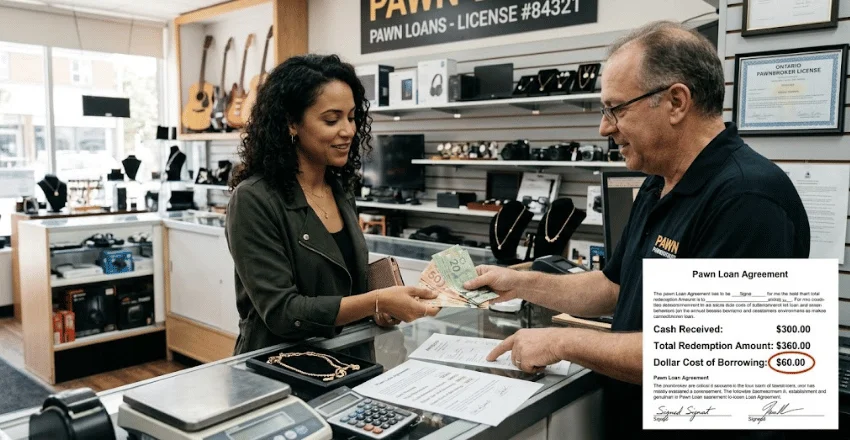
The cash offer is only half of the decision. Ask for the exact amount you will need to pay to reclaim your property on the due date.
Costs may include interest and other charges permitted under the agreement and applicable local rules. Canadian sources note that pawn borrowing can carry substantial interest and fees compared with many conventional forms of credit.
Focus on three numbers before signing:
- Cash received: The amount you take home.
- Total redemption amount: Everything you must pay to recover the item.
- Dollar cost of borrowing: The redemption amount minus the cash received.
For example, if you receive $300 and must pay $360 to recover the item, your short-term borrowing cost is $60. That calculation is often easier to understand than focusing on a single advertised rate.
Rules can also differ by province and municipality. Toronto, for example, requires businesses making these collateral loans to hold a specific licence. Ontario also maintains legislation addressing pawnbrokers. Check the rules where you live rather than assuming every Canadian transaction follows identical terms.
What Items Are Commonly Accepted?
The easiest property to pledge is usually one with clear resale demand and a verifiable value.
Common categories include jewellery, watches, newer electronics, gaming systems, musical instruments, tools, precious metals, and collectibles. Canadian pawnbrokers also advertise many of these categories directly.
Condition matters. Charge electronics, remove personal data where appropriate, and bring useful accessories. Documentation can also help with higher-value jewellery, watches, or collectibles.
A business can still decline an item. Low demand, authenticity concerns, damage, or difficulty establishing ownership may make the property unsuitable.
What to Check Before You Agree
Do not judge the transaction by speed alone. Read the ticket or agreement carefully and make sure the numbers are clear.
Confirm the following before handing over your property:
- the amount you will receive;
- the full cost required to reclaim it;
- the due date;
- any renewal or extension terms;
- what happens after a missed deadline;
- how the item will be stored; and
- the business’s licensing requirements, where applicable.
Expect to provide identification at many Canadian businesses. Some operators also record identifying information about goods as part of theft-prevention procedures. Exact requirements depend on local law and business policy.
Keep your receipt or pawn ticket in a safe place. Photographing the item before leaving it with the business can also create a simple record of its condition.
Alternatives Worth Checking First
A collateral loan can be useful because access to cash is often fast, but speed does not necessarily make it the cheapest option.
If you qualify, compare the total cost to a bank or credit union personal loan, line of credit, or another lower-cost borrowing option. Canada’s Financial Consumer Agency recommends looking at the full cost of borrowing, including interest, fees, and the repayment term.
For an item you no longer want, compare a direct sale with consignment or an online marketplace. Those options may take longer, but they can remove the lender’s resale margin from the transaction.
Your Next Step
Before accepting an offer, write down the item’s realistic resale value, the cash you will receive, and the full redemption amount. Compare the offer with at least one alternative source of cash.
If the numbers still make sense, read every term before signing. If losing the property would create a bigger problem than the cash solves, consider another option.
Frequently Asked Questions
Usually not for a standard collateral loan. The item itself secures the money advanced. Canadian consumer guides report that traditional credit checks are generally unnecessary for this type of borrowing.
You can lose the property used as collateral. The business may then sell it under the terms of the agreement and applicable local rules. Read the default and extension provisions before accepting the money.
There is no fixed percentage for every item. Canadian guides commonly cite offers of around 20% to 60% of resale or appraised value. Condition, demand, authenticity, and the business’s pricing policy all affect the final figure.
Pawn an item if you genuinely want it back and can confidently afford to redeem it. Sell an item you no longer need, especially if avoiding repayment costs matters more than recovering the item later.