

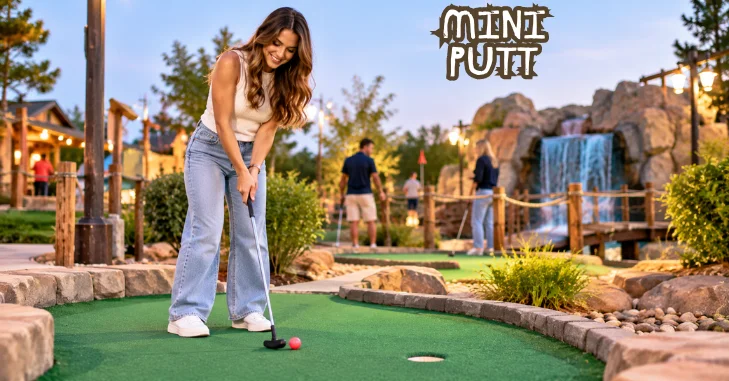
Mini putt is a simple putting game played on short courses filled with slopes, walls, obstacles, and creative features. Your goal is to finish every hole using as few strokes as possible. Across Canada, you’ll find everything from traditional outdoor courses to indoor glow-in-the-dark attractions.
You don’t need golf experience or special equipment to get started. Most venues provide a putter, ball, scorecard, and everything else required for a round. That simplicity makes the game an easy choice for families, dates, birthday parties, and casual outings.
Quick answer: It is a shortened, putting-only form of golf played on compact courses. Players take turns trying to sink their ball in each hole using the fewest strokes. Canadian venues may offer indoor, outdoor, themed, glow, or traditional courses, and local house rules can vary.
| Quick fact | What to know |
|---|---|
| Main goal | Complete the course with the lowest total score. |
| Typical course | Often 9 or 18 holes |
| Equipment | Putter, ball, scorecard, and pencil |
| Skill level | Suitable for beginners and experienced players |
| Common Canadian names | Mini putt, mini golf, miniature golf |
| Popular formats | Indoor, outdoor, glow, themed, adventure |
| Good for | Families, couples, friends, parties, group outings |
| Weather factor | Indoor courses can operate year-round. |
What Is Mini Putt?
A recreational version of golf that focuses on putting rather than long-distance shots. Courses use short holes, and players guide a ball around obstacles toward a cup. Walls, ramps, tunnels, curves, bridges, and themed features can make each hole different.
Outside Quebec, the activity is commonly called mini golf or miniature golf. The term “mini-putt” became particularly familiar in Quebec, where the game developed a strong cultural presence. Across Canada, people often use these names interchangeably when looking for somewhere to play.
Unlike standard golf, you don’t need a bag filled with different clubs. A putter is usually the only club you need during a round. Courses are also much smaller, so a game fits easily into an afternoon or evening outing.
How Do You Play?
Playing is straightforward, although each venue may post its own rules. Players generally start from a marked tee area and take turns hitting toward the cup. Each intentional stroke counts toward that player’s score for the hole. After everyone finishes the hole, record scores before the group moves on.
The process continues until everyone has completed every hole. At the end, players add their scores, and the person with the lowest total normally wins.
Basic Rules for a Casual Game
- Place your ball inside the marked starting area.
- Wait until the hole ahead is clear before playing.
- Make your first putt toward the cup.
- Count each intentional stroke you take.
- Continue putting until your ball enters the cup.
- Record your score before leaving the hole.
- Follow posted instructions for hazards, obstacles, and ball relief.
- Add your scores after completing the final hole.
Venue rules should take priority over informal rules your group normally follows. Some courses set stroke limits or special instructions for obstacles and hazards. Check the signs before starting to prevent arguments later.
How Scoring Works
Scoring follows one simple principle: fewer strokes are better. If you sink your ball on your first attempt, you record one stroke. If you need four attempts, your score for that hole is four. Many casual venues set a maximum number of strokes per hole to keep groups moving.
The exact limit can differ, so check the scorecard or course signs. If no maximum appears, your group can agree on one before starting.
| Result | Example score | What it means |
|---|---|---|
| Hole-in-one | 1 | The ball enters the cup on the first stroke. |
| Two strokes | 2 | One opening shot and one finishing putt |
| Three strokes | 3 | Three attempts are required. |
| Stroke maximum | Varies | Play stops at the venue or group’s limit. |
Keeping score is optional if everyone wants a relaxed outing. Competitive groups can track every stroke, while families with younger children may prefer flexible rules. The important part is agreeing on the approach before the round begins.
Indoor vs. Outdoor Courses in Canada
Canadian weather makes the indoor-versus-outdoor choice more important than it might be elsewhere. Outdoor courses can be especially enjoyable during warm spring, summer, and early autumn weather. Indoor venues offer a dependable alternative during rain, snow, extreme heat, or colder months.
Indoor courses often use black lights, colorful artwork, music, or elaborate themes. Some venues combine the course with arcades, bowling, food, or other attractions. These extras can make indoor locations useful for birthdays and larger group outings.
Outdoor courses tend to offer more open space and natural light. Landscaped designs may include rocks, plants, water features, and larger obstacles. Before travelling, confirm seasonal opening dates because many Canadian outdoor attractions close during winter.
Choosing a Course in Canada
Start by deciding what kind of outing you want. Families with young children may value simple holes, washroom access, parking, and nearby food. Couples or groups of friends might prefer a themed indoor course or a venue with other evening activities.
Location matters, but it shouldn’t be your only consideration. Look at recent course photos and confirm whether the attraction is indoors or outdoors. Also check accessibility, admission information, operating hours, and reservation policies directly with the venue.
Canadian directories show courses across Ontario, British Columbia, Quebec, and many other parts of the country. Options range from small seasonal attractions to large indoor entertainment centers. Current venue information matters because admission prices, schedules, and seasonal operations can change.
If you’re planning a larger Canadian trip, combine the activity with other nearby attractions. Lifevoria’s guides to things to do in Toronto and things to do in Victoria, BC, can help build a fuller day. The site also covers Canadian destinations and travel ideas for longer weekend plans.
Tips for Getting a Better Score
Good putting depends more on control than power. Before hitting, look at the entire route between your ball and the cup. Slopes and sidewalls may change the best line considerably. Use a comfortable stance and keep your lower body relatively still. Make a controlled pendulum-like stroke instead of hitting sharply at the ball.
Your first priority should be sending the ball along the intended line at a manageable speed. On holes with walls, a bank shot can sometimes provide a cleaner route. Think about the angle before swinging, especially on narrow or curved layouts. A powerful shot that bounces unpredictably often creates a harder second putt.
Five Simple Ways to Improve
- Study the slope before every shot.
- Use less force on short putts.
- Keep your putter face aimed at your target.
- Watch how other balls react to ramps and walls.
- Focus on leaving an easy second shot when a hole-in-one looks unlikely.
Practice also helps children develop basic putting control. The Waterloo Region District School Board, for example, suggests putting games as an enjoyable way for children to develop the skill. It even provides ideas for creating simple indoor courses from household materials.
Is Mini Putt Good for Families and Dates?
The activity works well for mixed-age groups because beginners can understand it quickly. Players don’t need golf experience, athletic training, or expensive personal equipment. Everyone can participate at their own pace while still enjoying some friendly competition.
Families can make the game easier for younger children by relaxing scoring rules. Older children may enjoy tracking scores and trying to beat their previous round. Parents should still check individual venues for age, supervision, and accessibility requirements.
It can also work well as a casual date because the game gives you something to do while talking. A round creates natural breaks in conversation without requiring constant attention. Indoor venues are particularly useful when Canadian weather makes outdoor plans uncertain.
Mini Golf, Miniature Golf, and Putt-Putt: Are They Different?
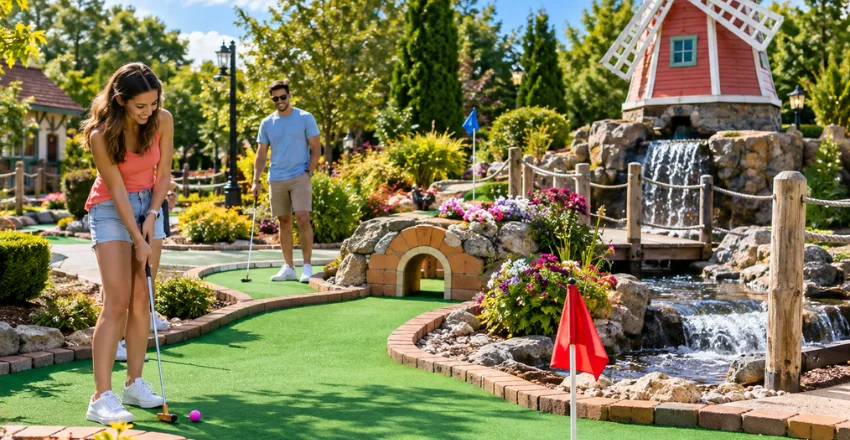
Mini golf and miniature golf are broad names for essentially the same recreational activity. “Mini putt” is another familiar Canadian expression, especially common in Quebec. For most casual players, course design matters more than the wording on the sign.
“Putt-Putt” has a more specific history because the name originated with an American miniature-golf business. In casual speech, people sometimes use it as a general term for the activity. Canadian searches are more likely to surface venues using either name.
When planning an outing, focus on the venue itself rather than the terminology. Look at its hole count, course photos, indoor or outdoor setting, accessibility, and other attractions. Those details tell you much more about the experience.
What Should You Bring?
Most venues supply the essential equipment, so you normally don’t need to own a putter or golf balls. Comfortable clothing and shoes are enough for most casual rounds. Outdoor courses may also call for sunscreen, a hat, or a light jacket.
Bring a payment method, and check whether the venue recommends booking in advance. Busy attractions may have longer waits during weekends, holidays, and school breaks. Calling ahead can also help if you need accessibility information or are bringing a large group.
For an outdoor round, check the forecast before leaving home. Rain can make exposed courses less enjoyable, while summer heat can affect younger children and older adults. An indoor venue removes most weather concerns.
Plan Your Next Round
The game offers a low-pressure activity that can fit a family afternoon, date, birthday, or group outing. The basic rules take minutes to learn, yet creative obstacles can keep the game challenging. Indoor and outdoor formats also give Canadians options across different seasons.
Before heading out, compare course style, current hours, pricing, accessibility, and booking requirements. Confirm time-sensitive details directly with the venue because schedules and admission can change. Then grab a putter, keep your strokes under control, and see who finishes with the lowest score.
Frequently Asked Questions
Is a mini putt the same as mini golf?
Yes, the terms are commonly used for the same general activity in Canada. “Mini golf” and “miniature golf” are broader terms, while “mini-putt” is especially common in Quebec. Individual courses can still differ greatly in design and difficulty.
How many holes are in a typical game?
Nine-hole and 18-hole formats are common. The number depends on the individual venue and course design. Check the attraction’s current information if the round length matters to your plans.
How long does a round take?
There is no fixed playing time because group size, course length, and crowds all affect the pace. Beginner groups may also take longer than experienced players. Allow extra time on weekends or during school holidays.
Can young children play?
Many courses are designed as family attractions and can work well for children. Individual venues may still have supervision, admission, or equipment policies. Check those details before visiting with younger players.
Can you play during winter in Canada?
Yes, as long as you choose an indoor course that operates in winter. Indoor and glow-style attractions remove most weather limitations. Outdoor courses are more likely to have seasonal schedules.
Do I need golf experience?
No golf experience is required for a casual round. The basic motion is easy to learn, and you can improve as you play. Beginners can focus on direction and speed rather than complicated technique.