

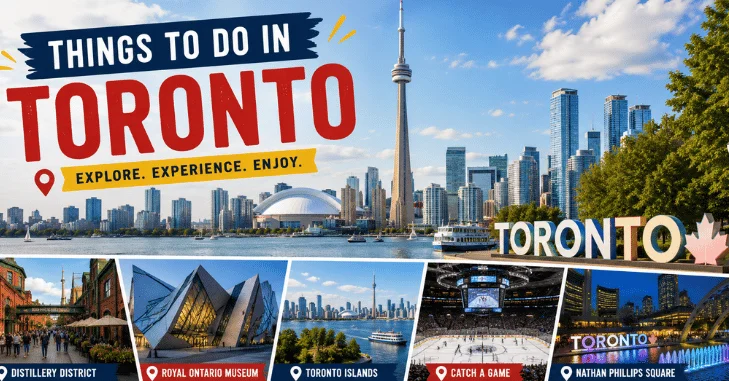
If you’re looking for things to do in Toronto, start with skyline views, waterfront time, neighborhood food, museums, and a few local favorites. For a first visit, the CN Tower, St. Lawrence Market, the islands, Kensington Market, and the Distillery District give you a strong sense of the city without wasting hours crossing town.
The city works well for quick weekends and longer stays because many major attractions sit close to downtown. You can also balance paid sights with parks, markets, public squares, and neighborhood walks.
| Experience | Time to allow | Typical cost | Good for |
| CN Tower | 1.5–2 hours | From C$47 adult | First-time visitors |
| St. Lawrence Market | 1–2 hours | Free entry | Food and local flavor |
| Toronto Islands | 3–5 hours | C$9.57 adult return ferry | Outdoors and skyline views |
| AGO | 2–3 hours | C$30 adult | Art and rainy days |
| Casa Loma | 2–3 hours | C$45 adult | History and architecture |
Current published rates come from the attractions and the City of Toronto. Prices and hours can change, so check before visiting.
Quick takeaways
- Cluster downtown attractions together to save travel time.
- Mix one major ticketed attraction with free neighborhood exploring.
- Save half a day for the islands during warmer weather.
- Use museums, markets, and galleries as reliable wet-weather options.
- Check event calendars because seasonal festivals can change your itinerary.
15 Things to Do in Toronto on Your Next Visit

1. See the city from the CN Tower.
The CN Tower is the obvious starting point for a first visit, and the view explains why. General admission includes the Main Observation Level and Lower Observation Level. Current timed adult admission starts at C$47. Book a clear day if the view matters most. Evening entry works well if you want the skyline after dark.
2. Eat your way around St. Lawrence Market.
Go hungry. St. Lawrence Market gives you a chance to sample prepared food, fresh produce, baked goods, and Canadian favorites in one stop. South Market currently opens Tuesday through Sunday and closes on Monday. Saturday also brings the Farmers Market, which runs from early morning into the afternoon.
3. Take the ferry to the Toronto Islands.
Few city outings change the scenery as quickly as the ferry ride across the harbor. Once across, you can walk, cycle, relax near the beach, picnic, or photograph the skyline. The City operates ferry service from Jack Layton Ferry Terminal. A current adult round-trip ticket costs C$9.57. Buying online can help you avoid the regular ticket line at busy times.
4. Walk through Ripley’s Aquarium
Ripley’s Aquarium sits beside the CN Tower, making the two easy to combine. Its underwater exhibits include sharks, rays, jellyfish, and thousands of other marine animals. This is a useful choice for families or a day when the weather turns poor. Destination Toronto lists it among the city’s signature attractions.
5. Spend a few hours at the Royal Ontario Museum.
The ROM is a strong choice if your interests jump between natural history, global culture, dinosaurs, archaeology, and art. You could spend several hours inside without seeing every gallery. Families can easily pair the museum with a walk along Bloor Street or nearby Queen’s Park. It also works well as the main indoor stop on a winter itinerary.
6. See Canadian and international art at the AGO.
The Art Gallery of Ontario sits within walking distance of Chinatown and Kensington Market. That makes it easy to build art, food, and neighborhood exploring into one afternoon. Adult single-day admission is currently C$30. The gallery also offers free admission on the first Wednesday night of each month from 6 p.m. to 9 p.m., with booking recommended.
7. Walk the Distillery Historic District
The Distillery District is made for slow exploring. Restored brick buildings and cobbled pedestrian streets now house cafés, restaurants, boutiques, galleries, and seasonal events. Walking the district costs nothing, so it fits nicely between paid attractions. Go later in the day if you want dinner or a more atmospheric evening visit.
8. Explore Kensington Market and Chinatown.
Kensington Market rewards wandering more than rigid planning. Browse vintage shops, small food counters, cafés, independent stores, and colorful residential streets. Chinatown sits close enough to combine with the same outing. Arrive around lunchtime and let whatever looks good shape the next hour.
For an even more unusual local stop, Lifevoria’s Kensington Market explains the Biblio-Mat, a surprise-book vending machine at The Monkey’s Paw.
9. Slow down in High Park.
High Park gives you trails, wooded areas, playgrounds, gardens, and space away from the downtown towers. About two-thirds of the park remains in a natural state. Weekend and holiday road closures currently limit private vehicle access, so transit is often easier. The TTC serves the park from nearby stations and seasonal routes.
10. Tour Casa Loma
A castle-style mansion may not be what you expect in the middle of a Canadian city, which is part of Casa Loma’s appeal. Tour the decorated rooms, towers, tunnels, and seasonal garden areas. Current adult general admission is C$45. Regular daytime touring runs from 9:30 a.m. to 5 p.m., though special events can affect access to certain areas.
11. Walk the waterfront.
You don’t need a ticket to enjoy the lake. Start near the harbor front, follow the shoreline, watch boats move through the harbor, or stop somewhere with a view toward the islands. This is an easy activity to fit between downtown attractions. It also gives you a low-cost break after a museum or observation-deck ticket.
12. See street art around Queen West.
For something less formal than a gallery, walk through the Queen West area and nearby Graffiti Alley. Murals and painted walls make this one of the easiest places to add photography to your day. Pair it with independent shops, cafés, or a walk west toward Trinity Bellwoods Park.
13. Visit Nathan Phillips Square and Sankofa Square.
Nathan Phillips Square is home to City Hall, the large TORONTO sign, public events, and a reflecting pool that becomes a skating rink in winter. The outdoor rink generally operates from November through March. From there, continue toward nearby Sankofa Square, the current name of the public space formerly known as Yonge-Dundas Square. It regularly hosts public programming and community events.
14. Plan an evening around sports, theater, or live music.
Don’t treat sunset as the end of your sightseeing day. Depending on the season, you can build an evening around professional sports, theater, comedy, concerts, or a late museum event. Check the date before relying on an old event page. Lifevoria’s Usher Toronto update is a useful example of why completed concert listings need current verification.
15. Leave room for seasonal Toronto
Your itinerary should change with the month. Summer suits islands, beaches, waterfront activities, street festivals, and patios. Winter brings skating, indoor museums, performances, and seasonal lighting.
The City also runs recurring cultural events throughout the year, including Nuit Blanche and winter celebrations.
If you’re travelling around a Canadian holiday, attraction and transit schedules may differ. Lifevoria’s Taylor Swift Vancouver Tickets guide explains why travelers should confirm local holiday hours rather than assume normal service.
How to Get Around Without Overspending
For most visitors, public transit is simpler than driving downtown. The TTC covers subways, streetcars, and buses across the city. The current adult PRESTO or debit/credit fare is C$3.30. Children aged 12 and younger ride free. A PRESTO day pass currently costs C$13.50.
Group nearby sights together. The CN Tower, aquarium, harbourfront, and ferry terminal work well on the same day. The AGO, Chinatown, and Kensington Market form another easy cluster. For more destination planning beyond this city, browse Lifevoria’s City Guides.
A Simple One-Day Itinerary
Start at St. Lawrence Market for breakfast or an early lunch. Walk toward the waterfront before heading to either the CN Tower or the aquarium. Spend the afternoon in Kensington Market and Chinatown, then finish around the Distillery District for dinner. If you prefer art, replace the afternoon neighborhood walk with the AGO. That plan keeps travel manageable while mixing food, landmarks, local streets, and one major ticketed attraction.
Make Your Toronto Visit Fit Your Style
There isn’t one correct itinerary. Pick two or three anchor attractions, then use nearby markets, parks, waterfront paths, and neighborhoods to fill the gaps. Our related guide, Things to Do in Winnipeg, goes further into this.
Use this list of things to do in Toronto as a starting point rather than a schedule you have to complete. You’ll see more of the city by grouping stops intelligently and leaving room for whatever you find along the way.
Frequently Asked Questions
Start with the CN Tower, St. Lawrence Market, the islands, Kensington Market, and the Distillery District. Add either the ROM, AGO, or Ripley’s Aquarium based on your interests and the weather.
Good no-admission options include High Park, the waterfront, Kensington Market, Chinatown, the Distillery District, Nathan Phillips Square, and neighborhood street-art walks. Some museums also run scheduled free-admission periods.
Yes. Ripley’s Aquarium, the ROM, High Park, the islands, and the CN Tower all work well with children. The TTC also allows children 12 and younger to ride free.
Two to three days gives most first-time visitors enough time for major downtown sights, a few neighborhoods, and the waterfront. Add another day if you want a slower pace, more museums, or a longer island visit.
Try a theater performance, comedy show, professional sports game, waterfront walk, live concert, evening attraction, or dinner in a neighborhood such as the Distillery District. Nightlife options range from cultural performances to late food stops.