

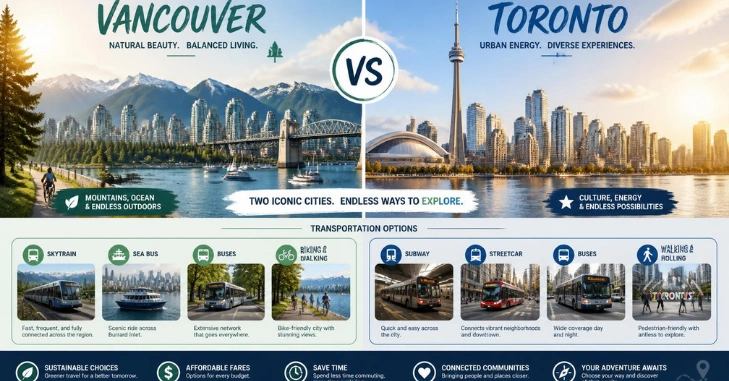
Travelling from Vancouver to Toronto means crossing most of Canada, and the right option depends on your time, budget, and reason for going. A nonstop flight is the fastest, VIA Rail turns the route into a four-day experience, and driving gives you the most control. This guide compares the real trade-offs for Canadian travellers in 2026. Laundromat Guide for Canada is a useful companion read here.
Short answer: Flying is the practical choice for most travelers because a nonstop flight takes about four and a half hours. Choose VIA Rail if the journey itself is part of the trip, and allow almost four days. Drive only if you want a multi-day road trip or need your own vehicle.
| Travel option | Typical travel time | Cost picture | Good choice for |
| Nonstop flight | About 4 hr 24 min in the air | Changes by date, airline, baggage, and fare type | Short trips, business travel, limited vacation time |
| VIA Rail’s The Canadian | About 3 days, 20 hr | The economy currently starts from C$514; sleeper fares are much higher. | Travellers who want the journey to be part of the holiday |
| Drive | Roughly 40 to 50 driving hours | Fuel, accommodation, meals, parking, and vehicle wear | Road trips, flexible stops, transporting your own car |
| Bus | Roughly 2 days, 21 hr on some itineraries | Multiple tickets and transfers may be required. | Travellers with a specific low-fare itinerary and flexible time |
VIA Rail lists the rail distance at about 4,406 km and currently operates the direct service twice weekly. Driving estimates vary by exact route, but an all-Canada road trip is roughly 4,100 to 4,400 km.
Vancouver to Toronto: Which Option Makes Sense?
For most people, flying is the recommendation. You cross the country in one day and avoid paying for several nights of accommodation along the way. For a Vancouver to Toronto trip, this makes flying the most practical choice for travellers with limited time.
The train makes sense when travel time is part of the experience rather than a problem. Driving suits people who want to see Canada at ground level or need a vehicle after arrival. A long-distance bus journey is possible, but it is much less straightforward. If you are still shaping the wider trip, the travel and lifestyle guides on Lifevoria can help you plan around your own time and budget.
Fly If Time Matters Most
A nonstop YVR-to-YYZ flight takes about 4 hours and 24 minutes. That makes air travel far quicker than every ground option. The flight itself is only part of your day. You still need to reach Vancouver International Airport, check in, clear security, collect bags in Toronto, and travel downtown.
From central Vancouver, the Canada Line connects Waterfront and YVR in about 25 minutes. At the other end, UP Express runs between Toronto Pearson and Union Station in about 28 minutes.
Advantages:
- You can complete the trip in a single day.
- Nonstop service removes the need for connections.
- Both airports have direct rail links to their downtown cores.
Trade-offs:
- Fares can change sharply with dates and demand.
- Checked baggage and seat choices can raise the final price.
- Airport procedures add several hours beyond the advertised flight time.
There is also a three-hour time difference. Toronto is ahead of Vancouver, so the arrival clock can make the flight look longer than it is.
For example, a 9:00 a.m. departure plus a 4-hour-24-minute flight would arrive in Toronto around 4:24 p.m. local time, before accounting for delays.
Take VIA Rail when the journey is the attraction.
VIA Rail’s The Canadian connects the two cities without a change of trains. The published average trip lasts about 3 days and 20 hours, covering approximately 4,406 km. Service currently runs twice a week.
The experience is closer to a rail holiday than ordinary intercity transport. You pass through the Rockies, Prairies, and northern Ontario before reaching Toronto.
Three main accommodation levels are offered: Economy, Sleeper Plus, and Prestige. Sleeper Plus adds sleeping accommodation, meals, and access to features such as lounge or dome cars.
Current 2026 VIA pricing shows why comparing classes matters. The economy starts from C$514. A Sleeper Plus upper berth starts from C$1,750 in the summer period and C$1,083 in the winter period, as shown by VIA.
Advantages:
- No airport connection or highway driving is required.
- The route itself becomes a major part of the holiday.
- Sleeper classes include accommodation for several nights.
Trade-offs:
- The journey takes almost four full days.
- Private sleeping accommodation can cost far more than an economy flight.
- With only a limited number of weekly departures, your dates need to fit the schedule.
Economy works for travellers who want the experience at the lowest rail price. A sleeper is more realistic if you expect to rest comfortably across several nights.
Drive if you want a cross-Canada road trip.
Driving gives you something neither flying nor rail can offer: control over where you stop and how long you stay. An all-Canada route follows major highways through British Columbia, Alberta, Saskatchewan, Manitoba, and Ontario. Depending on the exact roads and stops, expect roughly 4,100 to 4,400 km and about 40 to 50 hours behind the wheel.
Trying to cover that distance with minimal rest defeats much of the value of driving. A safer and more enjoyable plan spreads the journey over several days.
Advantages:
- You choose the schedule, stops, and overnight towns.
- Luggage limits are far less restrictive than on a flight.
- Your vehicle is already with you when you reach Ontario.
Trade-offs:
- Fuel is only one part of the cost.
- Hotels, food, and vehicle wear can make the trip expensive.
- Mountain and northern Ontario weather can affect your schedule.
A useful cost check is simple:
Road-trip cost = fuel + accommodation + meals + parking + vehicle wear and tear.
That calculation gives a fairer comparison with a plane ticket. Two people sharing a car and hotel rooms may reach a different conclusion than one person driving alone.
Consider the bus only after checking the full itinerary.
There is no simple cross-country coach experience comparable to the direct train. Current journey planners can produce bus combinations lasting close to three days, with several transfers. Some itineraries also travel through the United States. That raises additional questions about border documents, connections, luggage rules, and missed-transfer risk.
Advantages:
- A specific fare may work for a traveller with flexible dates.
- You avoid driving the vehicle yourself.
- It may connect cities that do not fit your preferred rail dates.
Trade-offs:
- Multiple transfers make the trip tiring.
- Some routes require crossing the Canada-U.S. border.
- A long coach itinerary saves little time compared with rail.
For most travellers, compare the full bus itinerary with an economy train fare and a basic flight before booking.
Think in Door-to-Door Time, Not Ticket Time
A four-and-a-half-hour flight does not mean a four-and-a-half-hour travel day. Airport transport, check-in, security, and baggage collection all matter. The reverse is also true for rail. Central stations can reduce transfer time, even though trains spend days crossing the country.
Ask yourself four questions before comparing prices:
- How many days can you give the journey?
- Do you need a car when you arrive?
- Is the journey part of the holiday?
- What does the total trip cost after bags, hotels, and local transport?
For a three-day visit to Toronto, losing almost four days to rail travel in each direction makes little sense. For a once-in-a-lifetime Canadian rail holiday, the same travel time may be the main reason to go.
What changes with the season?
Season affects each option differently. Flights operate year-round, but severe weather can disrupt airport schedules. Rail also runs through changing Canadian conditions, so leave some flexibility around important connections.
Road travel needs more planning. Mountain highways in British Columbia and long stretches of northern Ontario can face difficult winter conditions. Summer gives you longer daylight hours, though road construction and holiday traffic can add delays.
Rail pricing also changes by travel period. VIA’s published 2026 comparison shows a large seasonal difference for some Sleeper Plus fares, while the Economy starting price remains C$514 across the listed periods.
Make The Trip Fit The Reason You’re Travelling
There is no single transport choice for every traveller. A weekend visitor and a cross-country road-tripper are solving different problems. Start by deciding how much time you are willing to spend in transit. Then compare the complete cost rather than the headline ticket price.
If you value knowing how travel information is prepared before using it, you can also read how Lifevoria researches and maintains its reader-focused content. Once your transport choice is clear, check live schedules and fares for your dates before booking.
Conclusion
Choosing how to travel from Vancouver to Toronto ultimately comes down to what matters most to you: speed, cost, comfort, flexibility, or the experience of crossing Canada. There is no single option that works perfectly for every traveler, but the differences become much clearer when you compare the entire journey rather than just the ticket price.
For most travellers, flying from Vancouver to Toronto is the best practical choice. A nonstop flight takes only around four and a half hours in the air, allowing you to cross the country in a single day. Although airport transfers, security, baggage collection, and check-in add time, flying is still dramatically faster than travelling by train, bus, or car.
Frequently Asked Questions
A nonstop flight takes about 4 hours and 24 minutes in the air. The direct VIA Rail journey averages about 3 days and 20 hours. Driving normally requires roughly 40 to 50 hours of actual road time before rest stops and overnight stays.
The exact distance varies with your route, but a cross-Canada drive is roughly 4,100 to 4,400 km. The VIA Rail route is listed at 4,406 km.
Yes. VIA Rail operates the Canadian between the two cities. The current route page lists two departures per week and an average journey of 3 days, 20 hours, and 29 minutes.
Not necessarily. VIA’s current economy starting fare is C$514, while sleeper accommodation starts much higher. Airfares change by travel date, airline, and fare conditions, so compare the final price for your exact dates.
Yes. Toronto is three hours ahead of Vancouver, and both cities change their clocks at the same times each year, so the time difference stays the same. Remember that difference when reading flight arrival times.
When reaching Ontario, flying quickly matters most. Take the train for a multi-day Canadian travel experience. Drive when the road trip and flexible stops are part of your plan.