

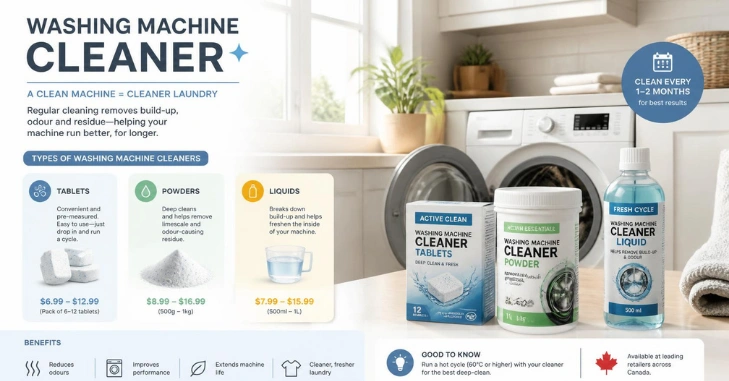
If your washer smells musty, leaves residue, or has gone months without maintenance, a washing machine cleaner can help remove buildup from areas you can’t easily reach. The right choice depends on washer compatibility, cleaner format, residue concerns, and how much effort you want to spend.
Short answer: For most Canadian households, start with a premeasured tablet or sachet that matches your washer type, including HE if needed. Use it in an empty machine as directed, clean the gasket and dispenser separately, and repeat about once a month, as the manufacturer recommends. This removes residue and odors without guesswork.
Washer Cleaner Options at a Glance
| Cleaner type | Main advantage | Main drawback | Best fit |
| Tablets | Premeasured and easy to store | Usually cost more per dose than value powders. | Simple routine maintenance |
| Powders or sachets | Affordable and often pre-portioned | Placement and cycle directions vary by brand. | Budget-conscious households |
| Liquid | Easy to pour and available in different formulas | Requires closer attention to dosing instructions | Shoppers who prefer liquid products |
All three formats can work well when used according to their labels. Compatibility matters more than whether the product comes as a tablet, powder, or liquid. The comparisons below show how Lifevoria researches and verifies its lifestyle content, so you can see what lies behind each recommendation.
How to Choose a Washing Machine Cleaner in Canada
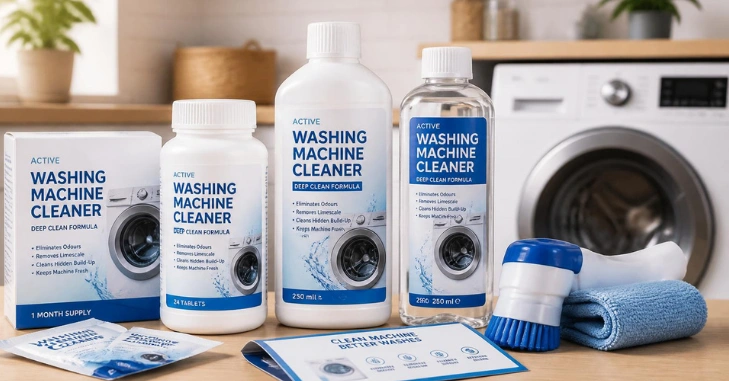
Washing Machine Cleaner: Check whether the manufacturer specifies a cleaning cycle, recommended product type, or restrictions on household cleaners. Then compare the label against the problem you are trying to solve. Odour, detergent film, mineral deposits, and visible gasket buildup are different maintenance issues.
Tablets: The simplest option
Tablets are convenient because each treatment is already measured. Several widely sold products are designed for front-load, top-load, and high-efficiency washers.
Pros:
- No measuring
- Easy to store
- Simple monthly routine
- Widely available in Canadian stores
Cons:
- Cost per treatment can be higher
- You still need to wipe seals and dispensers by hand
- Instructions vary between products
For households that want the least complicated routine, tablets are a sensible default.
Powder and sachets: useful for value
Powder products often come in single-use packets, which removes much of the measuring problem. Canadian store brands make this format easy to find at lower prices.
Pros:
- Often competitively priced
- Compact packaging
- Pre-portioned options are common
Cons:
- Some formulas go in the drum while others use another location
- Powder may need a specific water temperature or cycle
- Scent and ingredients differ widely
Read the package before use rather than assuming every sachet works the same way.
Liquid: Flexible But Label-Dependent
Liquid formulas appeal to people who prefer pourable household cleaners. Some products focus on odour, while others also make claims about scale or soap residue.
Pros:
- Easy to pour
- Many formula choices
- Convenient for shoppers who already prefer liquid cleaners
Cons:
- Dosing can require more attention
- Placement differs between products
- A strong fragrance may not suit every household
Never copy the directions from another brand. Follow the dose, placement, and cycle shown on the product you bought.
What Canadian Shoppers Are Paying in 2026
Canadian pricing varies by retailer, location, pack size, and promotion. These examples were checked in August 2026 and provide a useful benchmark for shopping.
| Example | Format | Price checked |
| Great Value, 3 x 40 g | Sachets | CAD $7.97 |
| Affresh, 3-count | Tablets | CAD $8.45 at Walmart |
| Tide, 3-count | Packaged cleaner | CAD $9.50 at No Frills |
| Glisten, 354 mL | Liquid | CAD $7.49 at Canadian Tire |
A low shelf price does not always mean the lowest cost per cleaning. Divide the package price by the number of recommended treatments before comparing value.
Also check whether the product addresses the specific issue you have. Paying less for an odour-focused formula may not help if mineral scale is your main concern.
How to Use Washer Cleaner Correctly
A good product can still disappoint when the directions are skipped. Use this process as a general framework, then follow your appliance manual and cleaner label.
- Read the washer manual and cleaner directions. Confirm compatibility, placement, cycle, and water-temperature instructions.
- Empty the washer. Do not run a maintenance treatment with clothing or towels inside.
- Add the recommended dose. Put it in the drum, basket, or dispenser only where the label tells you.
- Run the specified cleaning cycle. If your machine has a dedicated clean-washer setting, use it when the manufacturer directs you to do so.
- Finish the job by hand. Wipe the door, gasket, dispenser, and accessible surfaces after the cycle if residue remains.
Front-load machines deserve extra attention around the rubber door seal. Water, lint, detergent, and debris can remain in folds that the main cycle does not fully wipe away.
Front-Load and Top-Load Washers Need Slightly Different Care
A front loader has a door gasket that should be checked regularly. Pull back accessible folds gently and wipe away visible moisture or residue according to the appliance instructions. Top-load machines do not have the same front-door seal, but buildup can still form around the basket, dispenser, lid area, and other surfaces.
For either design, the product label should state whether it works with your machine type. HE owners should look specifically for high-efficiency compatibility.
Keep Your Washer Fresher Between Cleaning Cycles
A maintenance product works better when the appliance also gets basic day-to-day care.
- Remove finished loads promptly.
- Wipe visible moisture and residue from accessible seals.
- Clean detergent and softener dispensers as directed.
- Use the amount of laundry detergent recommended for your machine and load.
- Allow appropriate airflow between loads when your manufacturer recommends it.
These habits reduce the conditions that allow moisture and residue to remain in the washer between cycles.
For more practical ideas that make routine home care easier, browse Lifevoria’s everyday living guides and build the habits that fit your household.
What to Look for on the Label
Ignore flashy package claims until you have checked the practical details. Five label features matter most:
- Washer compatibility: front-load, top-load, and HE where applicable
- Residue target: odor-causing buildup, soap residue, or mineral deposits
- Treatment frequency: monthly, cycle-based, or as otherwise directed
- Scent: fragranced or fragrance-free
- Special compatibility: septic-safe claims when that matters to your home
If hard-water scale is your main concern, choose a formula that specifically mentions limescale or mineral deposits. An odor-focused product and a descaling product are not always the same thing.
The Verdict
For most households, a premeasured tablet or single-use sachet is the easiest starting point. It reduces dosing mistakes, stores neatly, and is widely available across Canadian retailers.
Washing machine cleaner: base it on the washer first, then the brand. If mineral deposits are a concern, prioritize a formula labelled for scale removal. If fragrance bothers you, check for a fragrance-free choice.
There is little reason to buy the largest pack on your first purchase. Try a small pack, follow the directions, and see whether it solves the problem you bought it for. Lifevoria aims to keep practical guides clear and research-based. Check any recommendation against your own appliance manual before you apply it to everyday decisions.
Frequently Asked Questions
Monthly use is a common manufacturer recommendation. Whirlpool Canada and Affresh both provide guidance around cleaning every 30 days or monthly. Your washer manual and the product label should take priority because recommended schedules can vary.
The visible drum is only one part of the appliance. Residue can collect in dispensers, seals, pumps, hoses, and other hard-to-inspect areas.
Many Canadian products claim to be high-efficiency models. Check for an HE compatibility statement before buying because individual formulas and appliance instructions vary.
Do not assume a homemade option is suitable for every appliance. Materials, seals, and manufacturer recommendations differ.
The main cycle may not remove residue trapped in the door seal, dispenser, filter area, or another accessible component. Clean those areas according to the manual. A persistent odor can also signal a maintenance issue that a chemical treatment alone will not solve. If repeated cleaning makes no difference, review the troubleshooting section of your manual or contact the appliance manufacturer.