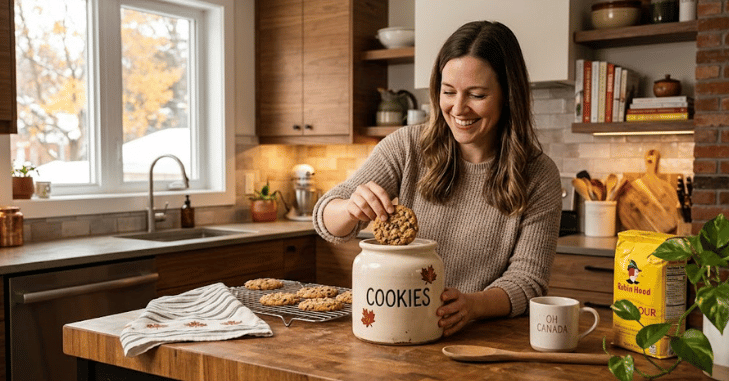

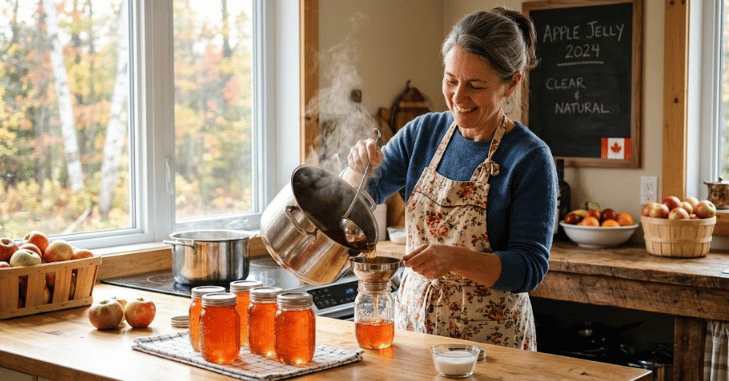
Fresh apples can become a clear, golden spread with only a few basic ingredients. This apple jelly recipe uses the fruit’s natural pectin instead of packaged pectin. The method is especially useful during Canada’s abundant late-summer and autumn apple season.
Cut unpeeled apples into pieces, simmer them with water, then strain the juice without pressing the fruit. Measure the juice, add sugar and lemon, and boil until it reaches the setting point. Cool it in clean jars and refrigerate, or use a tested canning recipe for pantry storage.
Apple Jelly at a Glance
| Recipe detail | What to know |
|---|---|
| Main ingredients | Fresh apples, water, granulated sugar, lemon juice |
| Added pectin | Not required |
| Best apples | Tart or moderately tart varieties |
| Preparation time | About 20 minutes |
| Cooking and straining | About 1½ to 2 hours |
| Setting temperature | Around 104°C (220°F) near sea level |
| Finished texture | Clear, spreadable jelly |
| Basic storage | Refrigerate after cooling |
| Pantry storage | Use a current tested canning recipe |
Apples naturally contain pectin, with useful amounts concentrated in their skins and cores. Leaving those parts attached helps the cooked juice gel later. Canadians have long used Canadian-grown apples this way in traditional jelly recipes.
What You’ll Need
This recipe works best with apples that have some acidity and aren’t excessively ripe. A mixture of tart and sweeter varieties can give the finished jelly a balanced flavour. Granny Smith, Cortland, McIntosh, or similar apples are practical Canadian choices.
| Ingredient | Amount |
|---|---|
| Fresh apples | 1.8 kg (4 lb) |
| Water | About 1.25 L (5 cups), or enough for cooking |
| Granulated sugar | About 150 g (¾ cup) per 250 mL (1 cup) strained juice |
| Fresh lemon juice | 30–45 mL (2–3 tbsp), to taste |
You will also need a large saucepan or preserving pot, a fine sieve, and cheesecloth or a jelly bag. Have a second pot available for the strained juice. Clean glass jars with secure lids are useful for storing in the refrigerator.
Do not reduce the sugar sharply if you want a traditional natural-pectin set. Sugar, along with the fruit’s acid and pectin, forms the gel structure. Reducing it can leave the finished spread runny even after cooling.
How to Make This Apple Jelly Recipe
The clearest results come from handling the cooked fruit gently. Pressing or squeezing the pulp forces fine apple particles through the strainer. Those particles do not ruin the flavour, but they can make the finished jelly cloudy.
1. Wash and cut the apples. Rinse the fruit under cool running water and remove damaged sections. Cut the apples into rough 2.5 cm pieces without peeling or coring them. 2. Cook the fruit. Place the apple pieces in a large pot and add the water. Bring everything to a boil, then reduce the heat and simmer for about 20–30 minutes. 3. Check for softness. The pieces should become soft enough to crush easily against the side of the pot. Stir occasionally to prevent fruit from sticking near the bottom. 4. Strain the juice. Place a jelly bag or cheesecloth-lined sieve over a large bowl. Transfer the cooked fruit and liquid, then allow the juice to drip until the flow almost stops. 5. Measure the liquid. Pour the strained juice into a measuring jug. Use about 150 g of sugar for every 250 mL of juice. 6. Add sugar and lemon. Transfer the juice to a clean preserving pot and stir in the measured sugar. Add lemon juice for brightness and additional acidity. 7. Boil to the setting point. Bring the mixture to a steady boil and cook until it reaches about 104°C (220°F). You can also use the chilled-plate test if you do not have a thermometer. 8. Check the set. Place a small spoonful on a cold plate and wait about one minute. Push it gently with your finger; a wrinkled surface indicates a stronger set. 9. Fill the jars. Remove the pot from the heat and skim away surface foam if desired. Ladle the hot jelly carefully into clean, heat-safe jars. 10. Cool and refrigerate. Let the jars cool according to safe handling practices, then cover and refrigerate them. Allow several hours for the texture to finish setting before judging the result.
A no-added-pectin version may need a longer boil than a commercial-pectin recipe. The exact time depends on the apples, juice concentration, pot size, and heat level. Watching the temperature and set test gives you better information than relying only on minutes.
How to Keep the Jelly Clear
Don’t squeeze the jelly bag while the cooked apples are draining. Extra pressure pushes fine solids into the liquid, creating a hazier result. Let gravity do the work, even if it leaves some juice behind.
A wide pot can also help during the final boil. Its larger surface area lets water evaporate more efficiently and concentrates the mixture faster. Keep enough empty space above the liquid because hot jelly can foam vigorously.
Skimming foam near the end can improve the jar’s appearance. It does not determine whether the jelly sets. Focus first on the correct sugar ratio, sufficient acidity, and proper cooking point.
Why Apple Jelly Sometimes Does Not Set
Undercooking is a common cause of a loose set. Jelly needs enough heat and concentration for the pectin network to form properly. If it never reaches its setting point, it may remain closer to syrup.
Fruit maturity can matter as well. Very ripe apples generally provide less effective natural pectin than firmer, less mature fruit. Combining ripe apples with a tart variety can improve consistency.
Changing the sugar ratio can also affect the set. Traditional fruit jelly relies on a balance between fruit pectin, sugar, and acid. Large recipe changes can alter that balance enough to prevent proper gelling.
Do not assume a warm jar has failed. Jelly continues to firm as it cools and rests. Give it several hours before deciding whether the texture needs attention.
Refrigerator Storage Versus Home Canning
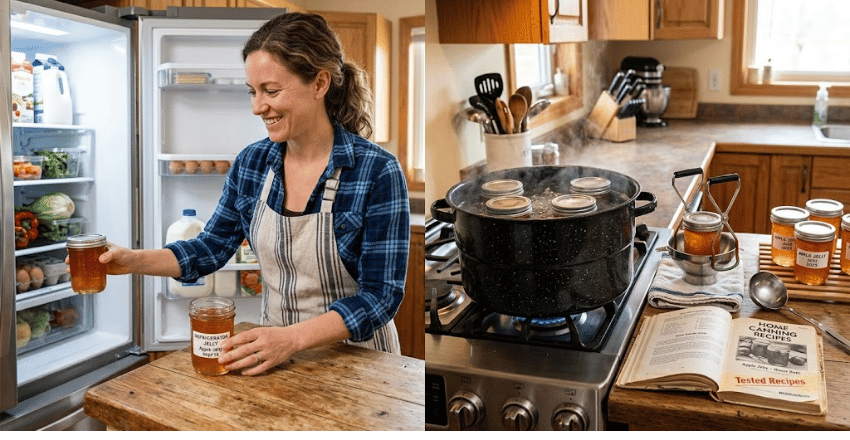
The simplest option is to treat this version as refrigerator jelly. Keep cooled jars refrigerated, and use clean utensils each time you serve. Refrigeration avoids implying that an untested formula is suitable for room-temperature storage.
For shelf-stable jars, follow a current tested canning recipe exactly. Health Canada advises home canners to use tested recipes, proper jars, recommended headspace, and the specified processing method. Jams and jellies are high-acid foods generally processed with boiling-water canning, but recipe-specific directions still matter.
Bernardin’s Canadian canning guidance includes tested apple jelly formulas with defined jar sizes, headspace, and processing instructions. Their published recipes commonly specify altitude adjustments when needed. Do not change ingredient quantities, jar sizes, or processing schedules in a tested formula.
Best Ways to Serve Homemade Apple Jelly
Warm toast is the easiest place to start. The clean apple flavour pairs well with salted butter and fresh bread. It also makes a useful alternative to maple syrup on a weekend breakfast.
Try spooning a little over Lifevoria’s fluffy buttermilk pancakes for a fruit-forward topping. The tart apple flavour can balance a richer breakfast without overwhelming it.
It also pairs well with aged cheddar, creamy Brie, or another favourite cheese. A thin layer can add sweetness to a sandwich or breakfast biscuit. You can even brush a small amount over cooked pork as a simple glaze.
For another Canadian sweet after brunch or dinner, Lifevoria’s classic butter tarts are an easy companion recipe. Their rich brown-sugar filling contrasts nicely with the fresher fruit flavour of homemade preserves.
Busy mornings also call for savoury options. Lifevoria’s freezer-friendly breakfast burrito recipe can handle the main meal while toast and jelly cover the sweet side. That combination works well when serving people who want different breakfasts.
Useful Apple Jelly Troubleshooting Guide
| Problem | Likely cause | What to try next time |
|---|---|---|
| Jelly stays runny | Mixture did not reach its setting point | Use a thermometer and chilled-plate test |
| Jelly looks cloudy | Cooked apples were squeezed during straining | Let the juice drip without pressing |
| Jelly becomes too firm | Mixture cooked too long | Stop once the set test succeeds |
| Flavour tastes too sweet | Apples lacked acidity | Use more tart apples and appropriate lemon |
| Jelly contains foam | Surface foam was not skimmed | Skim gently after cooking |
| Yield seems low | Fruit retained some juice | Accept some loss instead of squeezing the pulp |
Keeping notes can make later batches more predictable. Write down your apple varieties, strained juice quantity, sugar amount, and final cooking temperature. Those details help you repeat a successful batch next season.
Frequently Asked Questions
Can I make this apple jelly recipe without packaged pectin?
Yes, because apples contain natural pectin in their skins, cores, and flesh. Firmer, tarter fruit usually gives you a better starting point. Keeping the skins and cores during cooking helps extract more of that natural pectin.
What are the best apples for jelly in Canada?
Tart apples like Granny Smith work well, while Cortland and McIntosh add familiar apple flavour. Mixing varieties can produce more balanced sweetness and acidity. Choose sound fruit and remove bruised or spoiled areas before cooking.
Why shouldn’t I squeeze the jelly bag?
Squeezing forces small pieces of cooked apple into the strained juice. Those solids make the final preserve look cloudy rather than clear. Gentle draining takes longer but gives a brighter appearance.
How do I know when the jelly is ready?
A preserving thermometer should read around 104°C (220°F) near sea level. You can also put a spoonful onto a chilled plate and let it cool briefly. If the surface wrinkles when you push it, the gel is setting.
Can I store homemade jelly in the pantry?
Use pantry storage only when following a tested canning formula and its complete processing directions. Health Canada recommends tested recipes and the correct canning method for home-preserved foods. Refrigerate this base recipe unless you deliberately switch to a validated canning process.
Make the Most of Apple Season
Fresh apple jelly is a practical way to preserve seasonal fruit flavour without buying packaged pectin. Keep the skins and cores, strain patiently, and judge the final boil by temperature or a set test. Those small choices have the biggest effect on clarity and texture.
Start with a refrigerator batch if you are new to preserving. It lets you learn how the juice behaves without changing the recipe for shelf storage. Once you want pantry-stable jars, move to a currently tested Canadian canning formula and follow every processing detail.